What shows up next is usually chosen to keep them watching—not to help them think, learn, or grow.
Ranking systems learn what holds a child’s eyes. That is often not the same as what a parent wants for a developing mind: real interest, the right level of challenge, curiosity, or calm investigation. Ads help fund that race for time. The deeper problem is the race itself.
Mind Reclaim · Bring attention and creativity back home.
A social network’s business best interest is usually not the same as a parent’s best interest for their child.
Parents want focus, sleep, kindness, learning, and a sturdy sense of self. The feed’s ranking is built to win minutes. When those goals conflict, the product is not confused about which one pays the bills.
This is influence and misaligned incentives—not mind control, and not a secret plot. It is a design choice repeated at huge scale.
Most “For you” and autoplay queues are not curated like a good teacher or a careful librarian.
They are usually not chosen because the content:
They are ranked for what is predicted to keep this child on-screen longer. That can mean content that pokes strong, fast feelings—fear, outrage, status, envy, craving—because those feelings are reliable at pulling attention back.
Former Google design ethicist Tristan Harris has described the wider contest for attention this way:
“It’s because the game is getting attention at all costs. And the problem is it becomes this race to the bottom of the brainstem, where if I go lower on the brainstem to get you… using my product, I win.”
— Tristan Harris, CBS 60 Minutes (“brain hacking”) · source
A careful note: Children are not “animals.” They are growing people. The point is the incentive: hold them, even when holding them is not helping them.
Scholar Shoshana Zuboff describes a business logic she calls surveillance capitalism: take everyday behavior, turn it into data, predict what people will do—and use that power in markets that can also shape what they do next (Journal of Information Technology, 2015).
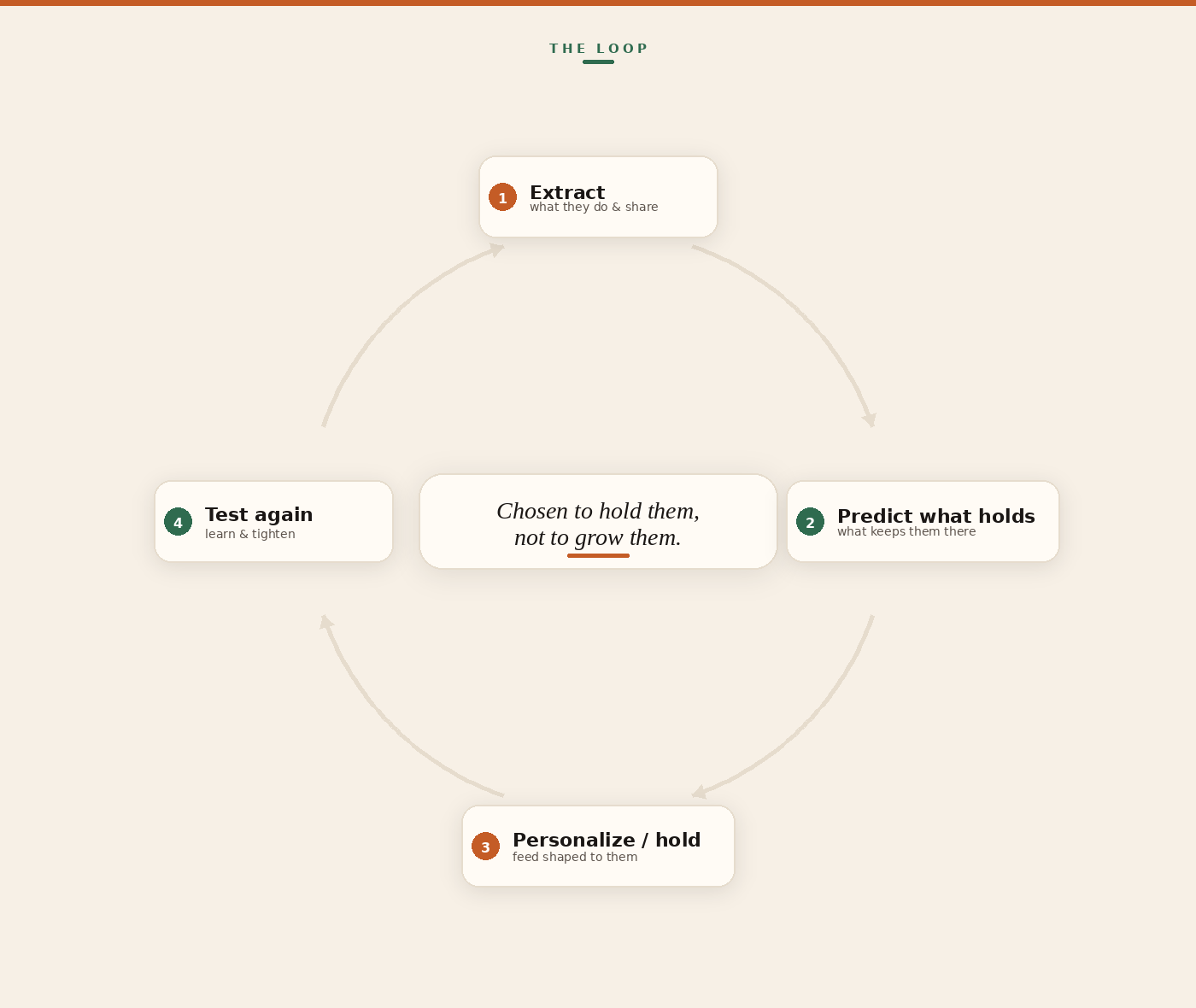
In parent language, the feed often works like this:
Likes, watches, pauses, searches, follows, captions, photos, videos, and other signals become a trail.
The system guesses what will keep this child scrolling or watching.
The queue reshapes around that guess.
Small changes run all the time to win more minutes.
Chosen to hold them, not to grow them.
Zuboff’s Big Other is a name for that always-on recording and sorting architecture across apps and devices—not one villain in a tower, and not science fiction. It helps explain why the feed can feel like it “knows” a child without anyone sitting down to teach, guide, or care.
Ads and commercial targeting help fund the engagement race. Monetization matters—but on this page, it stays in the background. The center is what gets optimized: time on screen, not growth of mind.
Children and teens are still building attention, judgment, sleep habits, and a sense of self. A machine that rewards whatever holds them longest can pull against the slow work of growing up: thinking things through, tolerating boredom, caring about truth, and staying present with real people.
Designs made for adult engagement are not automatically right for developing minds (see APA; U.S. Surgeon General).
Not every child is affected the same way. For some young people, social media also helps them find friends and support. Our focus is excess, misaligned ranking, and what families can do—without scare-teen stories or conspiracy talk.
We speak of influence and commercial pressure, not mind control or “guaranteed addiction.”
Feeds are one pressure. Generative AI is another. Default AI use can skip the struggle that builds understanding—drafting, checking, and making something yourself.
Feeds steal time and focus. Default AI can skip the work of learning.

